

Views: 0 Author: Site Editor Publish Time: 2026-05-07 Origin: Site
A flat plastic sheet is not what customers notice first. What they recognize is the finished hard-shell suitcase, and the Luggage Vacuum Forming Machine is the stage that turns sheet material into that visible shell. In modern Luggage Making, this machine is one of the most important links in the line because it influences shell shape, surface quality, repeatability, and downstream fit. RBT MACHINERY has over 25 years of experience in luggage production equipment and offers vacuum forming solutions from 20 inches to 32 inches for hard-shell suitcase manufacturing.
A luggage vacuum forming machine heats a plastic sheet until it becomes formable, places it over a mold, and then uses vacuum suction to pull the sheet tightly against the mold surface. After cooling, the shell keeps its shape and moves on to cutting, drilling, and assembly.
That sounds simple, but this stage does far more than just shape plastic. It affects shell contour, wall distribution, visible detail, and how well the part can move into later production steps. If forming is unstable, even a good mold and good material can still produce weak results.
Vacuum forming stays central to hard-shell luggage production because it combines design flexibility with practical output. It allows manufacturers to create a wide range of shell styles, textures, and sizes without relying on a more complicated process than necessary.
It also fits the real needs of luggage factories. A production line needs more than one attractive sample. It needs a process that can make consistent shells day after day. That is why vacuum forming remains such a core stage in hard-shell luggage manufacturing.
The process begins with heating. The sheet must reach a proper forming window so it softens evenly instead of becoming too stiff in some areas and too loose in others. Once the sheet is ready, the forming stage begins. Vacuum pulls the sheet over the mold, helping the shell capture the intended shape.
After that comes cooling. Cooling is not only about making the shell hard again. It also determines whether the shell holds its form cleanly after it leaves the mold. Only when the shell is stable can it move on to CNC cutting and later assembly.
Every step has its own risks. Uneven heating can create stretching problems. Weak or unstable vacuum can lead to soft detail or incomplete forming. Poor cooling can create shape drift or warping after release.
That is why a good vacuum forming machine should be seen as a full system rather than a single heater with a mold. Heating control, vacuum response, mold behavior, and cooling all work together to determine shell quality.
Process step | What happens | Key control point | Common risk |
Sheet heating | Thermoplastic sheet is softened for forming | Even temperature and correct heating time | Uneven stretch or local overheating |
Forming | Vacuum draws sheet onto the mold | Vacuum capacity and timing | Weak detail or incomplete shaping |
Cooling | Formed shell is stabilized after molding | Even cooling and sufficient cooling time | Warping or shape drift |
Release | Shell separates from mold | Controlled demolding and part stability | Deformation after release |
Transfer | Shell moves to cutting and later assembly | Dimensional consistency | Downstream fit problems |
Common luggage shell materials include ABS, polycarbonate, PC/ABS, and PP. These materials do not behave the same way, so forming results also differ. ABS is often valued for its cost balance and toughness. Polycarbonate is known for impact resistance and premium shell performance. PC/ABS blends are popular because they combine toughness with good processing behavior. PP may also be used in some applications because of its low density.
For manufacturers, material choice affects not only shell performance, but also how the sheet responds to heating, forming, and cooling. That is why a useful forming setup must match the material, not just the machine size.
Lightweight luggage manufacturing does not begin only when the shell leaves the mold. It starts with the sheet and the material choice before forming even starts. A lighter shell still needs enough stability, clean shaping, and reliable downstream trimming.
That is one reason vacuum forming works best when it is treated as part of a connected production system. Material control upstream helps the machine form the shell more predictably, and that stability carries through to later cutting and assembly.
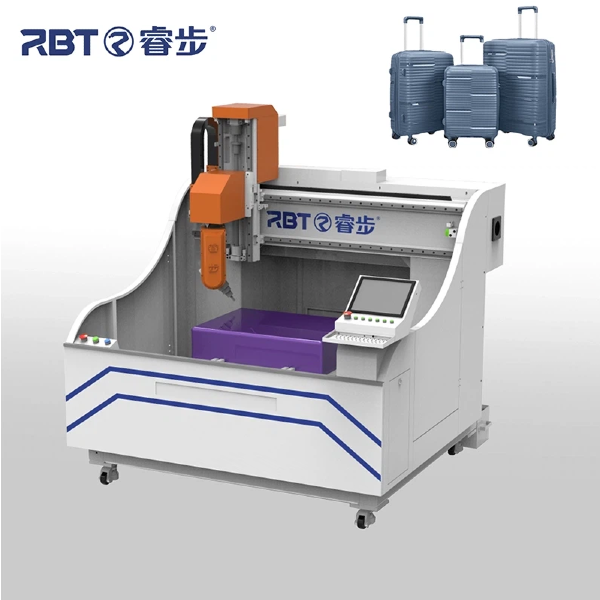
In daily production, the most important machine features are not always the ones that sound most impressive in a brochure. What matters most is whether the machine can keep shell quality stable. Heating control matters because the sheet has to soften evenly. Vacuum stability matters because the shell needs to capture the mold clearly. Cooling support matters because the part must keep its shape after release.
These are the features that reduce defects and improve repeatability. A machine that performs these functions well usually adds more value than one that only advertises high capacity.
Automation matters, but not only because it can make the cycle faster. Its greater value is process consistency. A more stable control system, repeatable recipe settings, and more predictable operation help reduce waste and make shell output more reliable.
For a luggage factory, that means automation should be judged by how well it supports repeatable shell quality, not just by how quickly the machine can complete one cycle.
A forming machine is only one stage in the luggage line. Before it, extrusion determines sheet quality. After it, CNC cutting determines edge finish, opening accuracy, and downstream fit. If the incoming sheet is unstable, forming becomes harder to control. If the shell leaving the mold is inconsistent, cutting and assembly will suffer later.
That is why vacuum forming should not be treated as an isolated machine decision. Its performance is closely connected to the full production chain.
The best shell quality usually comes from better coordination across extrusion, forming, and cutting. Stable sheet thickness helps forming. Stable forming helps accurate trimming. Accurate trimming helps assembly and product consistency.
RBT MACHINERY’s product structure reflects this logic by presenting extrusion, forming, and cutting as connected luggage-production solutions rather than unrelated machines.
Capacity planning should begin with the shells the business actually makes. A factory producing mostly 20-inch and 24-inch products may not need the same forming strategy as one focused on larger 28-inch to 32-inch shells or family luggage sets.
Product mix matters just as much as machine size. The forming system should support the shell sizes and volume patterns that drive the real business, not only the biggest size the line may occasionally produce.
More capacity is only useful when shell quality stays stable at that capacity. A machine that runs more parts but creates more defects does not really improve production performance.
That is why buyers should think about defect tolerance, mold changes, material behavior, and downstream fit together with output volume. Real production value comes from repeatable capacity, not only from larger numbers.
A strong lightweight shell does not come from one material or one machine feature alone. It comes from process discipline across the line: stable sheet quality, even heating, controlled vacuum, balanced cooling, and clean trimming.
That is why lightweight shell quality depends on a controlled system. A shell can be lighter and still remain commercially strong if the production process keeps shape, surface, and consistency under control. In hard-shell luggage production, that balance is what turns a machine function into a product customers will accept.
A Luggage Vacuum Forming Machine is more than a shaping device. It is a core production asset that influences shell quality, consistency, and how efficiently a factory can scale hard-shell output. For RBT MACHINERY, this means treating forming as part of a complete luggage-production workflow rather than a single isolated step. If you want to improve shell repeatability, support lightweight designs, and strengthen your overall Luggage Making process, contact us to learn more about our 24 inch Luggage Vacuum Forming Machine and broader forming solutions.
It heats a plastic sheet, forms it over a mold with vacuum suction, cools the shell, and prepares it for later cutting and assembly.
Common materials include ABS, polycarbonate, PC/ABS, and PP. Each material behaves differently in forming and affects shell feel, strength, and process stability.
Because it is the stage that creates the visible shell. It directly affects shell shape, wall thickness, surface quality, and downstream cutting consistency.
No. Forming depends on upstream sheet quality and also affects downstream trimming and assembly. Better coordination across extrusion, forming, and cutting usually leads to better finished luggage quality.


