

Views: 0 Author: Site Editor Publish Time: 2026-04-16 Origin: Site
Machine size decisions should begin with the products the market actually moves, not with the biggest specification on a catalog page. For many factories, Luggage Making becomes more efficient when forming capacity follows real demand for 20-inch carry-ons, medium check-in cases, and larger family travel sizes instead of oversizing the whole line too early. RBT MACHINERY, with more than 25 years of experience in luggage production equipment, offers a luggage vacuum forming machine range that already covers common shell sizes from 20 inches to 32 inches, which makes this discussion less about abstract theory and more about practical production planning.
Size planning becomes much easier when it starts with how luggage is actually used. In common retail size guides, 18" to 20" is usually treated as carry-on range, 23" to 24" as medium checked luggage, 25" to 27" as large checked luggage, and 28" to 32" as extra-large checked luggage. That makes 20", 24", 28", and 32" especially useful reference points because they correspond to travel habits customers already understand.
A 20-inch shell is closely linked to short-trip mobility and carry-on convenience. A 24-inch shell often sits in the practical middle, serving travelers who need more packing space without moving into oversized territory. A 28-inch shell is strongly connected to large check-in demand, while a 32-inch shell tends to serve long-trip, family, or high-volume packing needs. When a forming line is planned around these real usage categories, machine investment becomes easier to justify because the size logic follows product demand instead of guesswork.
Not every factory should plan the same way, even when they all produce hard-shell luggage. A line focused on export bundles or coordinated travel sets may need strong repeatability across several common sizes, while a niche premium brand may concentrate more heavily on a narrower size mix with stricter appearance control. The question is not only which sizes exist in the market. The question is which sizes your customers are actually ordering in volume.
That is why forming priorities should follow order structure. If a factory mainly ships carry-on and large check-in combinations, then 20-inch and 28-inch capacity may deserve more attention than occasional 32-inch demand. If a program serves family luggage sets or long-trip collections, then larger forming capability can become more central. RBT MACHINERY’s forming category structure itself reflects this practical market logic by separating 20", 24", 28", 30", and 32" machine options rather than treating all shells as one generic category.
Luggage size | Typical travel use | Shell demand pattern | Production planning note |
20" | Carry-on and short trips | High repeat demand in many collections | Good for fast turnover and frequent orders |
24" | Medium checked travel | Flexible mid-range demand | Useful bridge size for mixed collections |
28" | Large checked luggage | Strong demand in standard retail sets | Important for mainstream large-shell output |
30" | Expanded large-capacity travel | More selective but valuable in some markets | Best planned around specific SKU mix |
32" | Extra-large family or long-trip use | Lower frequency but high-volume positioning | Add when product mix clearly supports it |
A larger machine does more than provide a bigger forming area. It also changes how sheet material is used, how molds are planned, and how production is scheduled. Once the shell size increases, draw depth, heating behavior, and mold handling all become more important. A forming decision that looks simple on paper may affect material efficiency and operating rhythm every day.
RBT MACHINERY’s product pages for 20", 24", 28", and 30" models show that these machines are designed specifically for trolley luggage shell thermoforming in materials such as PC, PC/ABS, ABS, and PP. The 28-inch product page also lists max hourly output figures for 20", 24", and 28" shells in ABS and PC, which highlights an important planning point: size decisions are connected not only to physical fit, but also to output expectations across different shell formats.
A larger machine can certainly support a broader shell range, but that does not automatically make it the smarter option for every line. The more useful question is whether the extra range actually improves the factory’s real product mix.
Many buyers assume that buying bigger is the safest path because it leaves room for future growth. Sometimes that is true. Just as often, oversized capacity creates hidden inefficiencies. A machine that is regularly underused can increase energy consumption, reduce material efficiency, and create more idle forming range than the line actually needs.
This matters most when the product mix is concentrated. If a factory mainly runs 20-inch and 24-inch shells, a larger forming platform may offer flexibility that looks attractive but delivers limited daily value. Extra capacity only becomes productive when order structure, mold strategy, and scheduling actually use it. Otherwise, the line may carry more machine than the workload requires.
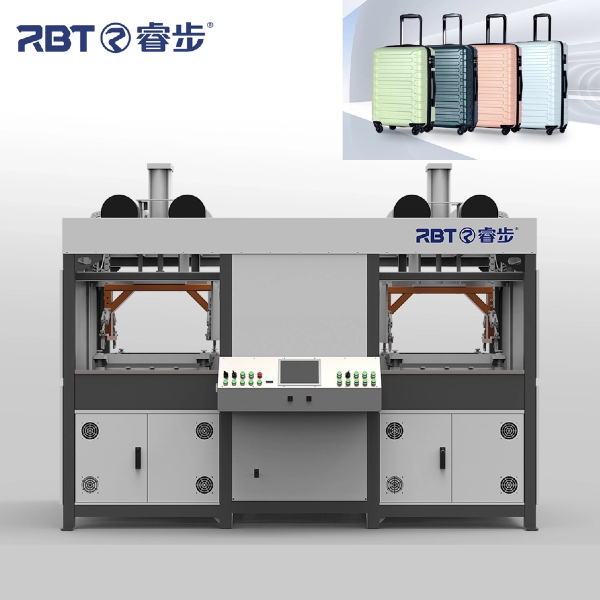
A focused size strategy works well for some factories, while others need more flexible planning. If a plant has stable demand around one or two core shell sizes, dedicated production can improve rhythm, simplify changeover, and make output easier to predict. This is especially useful when the business is built around standard travel sets or repeated export orders.
Mixed-size scheduling becomes more valuable when the order pattern changes often or when the product range is broader. In that case, the goal is not to optimize one shell size perfectly, but to keep multiple sizes moving through the line with manageable changeover and stable quality. RBT MACHINERY’s 20" to 32" model coverage supports this kind of planning because the forming portfolio is already aligned with common luggage size bands rather than forcing a one-size-fits-all production concept.
One common planning mistake is to let the best-selling size dominate the machine decision too completely. A strong 20-inch carry-on program may still depend on matching 24-inch and 28-inch products for set sales. A growing 28-inch line may still need 30-inch or 32-inch support if the brand is moving into larger family-travel formats.
That is why the real planning unit is not only one flagship size. It is the SKU mix. Shell variation, order frequency, set matching, and mold turnover all influence what machine size will perform best in daily use. The more coordinated the product family, the more important it becomes to plan forming capacity around the whole selling structure rather than one popular shell.
A shell does not stop being a production item after forming. It still has to move into cutting, assembly, and final matching. If the forming decision creates shell sizes that are harder to trim efficiently or harder to coordinate across a luggage set, then an upstream capacity choice can create downstream friction.
RBT MACHINERY’s site presents luggage production as a connected chain that includes extrusion, forming, cutting, stitching, and assembly, not as isolated machine islands. That matters here because shell size planning should support the flow of the whole line. A machine that can form a larger shell is not automatically the right answer if the rest of the process cannot support that size efficiently.
A 32-inch shell should not be treated as a simple extension of 28-inch production. Market positioning changes, packing expectations change, and the product role changes. General luggage size guides place 28" to 32" in extra-large checked categories, which means this range often serves a different travel purpose from standard large luggage.
That difference affects production planning. Larger shells may need different scheduling assumptions, different order logic, and different expectations for sell-through compared with 28-inch products. When factories treat 32-inch demand as a minor variation instead of a different planning category, they risk adding size range without adding enough volume to justify it.
A larger forming machine becomes a strategic move when the business shows clear signs that bigger shells are no longer occasional products. That may happen when a brand expands into broader travel sets, grows its check-in and family luggage lines, or serves markets where larger luggage is more common in retail demand. It also makes more sense when the factory wants better coverage across 20", 24", 28", 30", and 32" without forcing too much compromise into one narrow production setup.
RBT MACHINERY’s range already includes distinct product paths for 20", 24", 28", 30", and 32" thermoforming, and its forming pages position these machines for hard-shell luggage materials such as ABS and polycarbonate. That gives manufacturers a clearer way to scale capacity in steps instead of jumping blindly to oversized equipment.
For companies working seriously in Luggage Making, the right size decision is the one that matches what the market buys, what the molds require, and what the production line can run efficiently every day. A well-planned luggage vacuum forming machine strategy should support carry-on demand, medium and large check-in programs, and future growth without turning flexibility into waste. If you are planning your next shell production layout, contact us to learn how RBT MACHINERY and our 32 inch Luggage Vacuum Forming Machine solutions can help you build a more practical and scalable forming plan.
Because these sizes map closely to how the market already understands luggage usage, from carry-on to medium checked, large checked, and extra-large checked travel. That makes them useful reference points for both product planning and forming capacity.
No. A larger machine may offer more size range, but it can also increase material use, idle capacity, and operating cost if the actual product mix is narrower than the machine’s capability.
Because the shell still has to move into cutting, assembly, and final set matching. A machine choice that looks fine at the forming stage can create inefficiency later if the rest of the line is not aligned.
When larger shells are becoming a stable part of the business, such as broader family sets, long-trip product lines, or markets with stronger demand for extra-large checked luggage. RBT MACHINERY’s forming portfolio includes 30" and 32" options for that stage of expansion.


