

Views: 0 Author: Site Editor Publish Time: 2026-04-09 Origin: Site
A hard-shell suitcase depends heavily on the sheet that enters forming, which is why Luggage Making begins much earlier than the shell itself. Before a product reaches thermoforming or CNC trimming, the extrusion stage has already shaped much of its final performance. That is why the real comparison is not simply twin-screw versus multi-screw as machine names, but which extrusion route gives a luggage line the right balance of melt quality, color control, thickness stability, and production flexibility. RBT MACHINERY, with more than 25 years of experience in luggage production equipment, approaches this question from the standpoint of final shell quality rather than isolated machine theory.
A luggage sheet is not just a flat output. It has to heat evenly, stretch predictably, hold color well, maintain thickness consistency, and support a shell that will later be trimmed and assembled without unnecessary variation. That is why extrusion cannot be discussed as a separate upstream topic with little connection to the finished product.
For a luggage line, the sheet must be stable enough to support the look and performance of the final shell. A product aimed at clean appearance and color consistency may need one kind of process control, while a line using more additives, recycled content, or layered structures may need another. The real starting point is always the performance target of the sheet, not the popularity of a machine label.
Poor sheet quality rarely stays hidden. If melt quality is unstable, problems often reappear later as uneven heating, color variation, weak shell areas, poor forming consistency, or trimming issues. What looks like a forming or cutting defect may actually begin in extrusion.
That is why luggage sheet extrusion should be judged by its downstream impact. A sheet that seems acceptable at the output stage can still become expensive if it causes reject rates later. For brands building premium or lightweight luggage, this matters even more because the final product leaves less room for process error.
Twin-screw extrusion is often preferred when the formulation is more demanding. Once colorants, additives, fillers, or recycled content enter the recipe, stronger mixing becomes more valuable. Better dispersion helps the sheet stay more uniform, which supports better appearance and more stable downstream performance.
For luggage sheets, this is not only a technical benefit. It directly affects shell appearance, color stability, and forming behavior. A better-mixed sheet usually behaves more predictably when heated and shaped, which makes it easier to maintain product quality across repeated runs.
Twin-screw systems are also often stronger in venting and melt control, especially when the material system is less forgiving. If a sheet program requires more process discipline to maintain surface quality and melt stability, stronger control at the extrusion stage becomes more important.
This is one reason twin-screw solutions are often attractive for luggage sheet lines that aim for cleaner finishes, tighter visual standards, or more stable forming results. Their value is not simply that they are more advanced. Their value is that they often help create a more predictable sheet for the next stages of production.
Comparison point | Twin-screw | Multi-screw | Best fit for luggage sheet lines |
Mixing strength | Strong for colorants, additives, and compounding | Higher flexibility for more demanding recipes | Twin-screw for most quality-focused standard lines |
Venting control | Good when melt stability matters | Can support broader upstream process arrangements | Multi-screw for tighter process windows |
Recipe flexibility | High and practical | Broader in more complex systems | Multi-screw for changing product mixes |
Changeover practicality | Easier to standardize for repeat runs | More capability but more discipline required | Twin-screw for stable SKU programs |
Investment logic | Strong balance of quality and control | Worth it when added complexity clearly adds value | Depends on shell strategy |
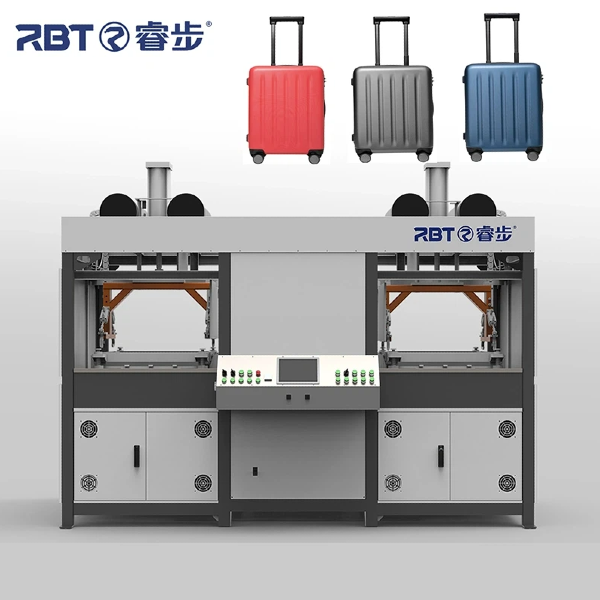
In simple terms, multi-screw systems go beyond the standard two-screw arrangement. In luggage production, that can mean three-screw or four-screw sheet extrusion setups when the formula or product target requires broader process control.
A multi-screw route becomes more useful when the sheet program is harder to manage with a more standard layout. This may involve layered structures, broader material variation, stricter visual targets, or more demanding process windows. The point is not that more screws always create a better result. The point is that broader capability can become valuable when the sheet target itself becomes more complex.
A more advanced setup does not automatically create a better business decision. If the product range is relatively stable and the line mainly runs standard hard-shell sheets, a well-matched twin-screw route may already provide the right level of control. In that situation, extra complexity may raise management difficulty without creating enough additional value.
But if the line is moving toward more premium finishes, layered sheet strategies, more recipe changes, or stricter appearance control, then multi-screw capability can be easier to justify. The best decision depends on how demanding the actual sheet program is, not on how impressive the machine sounds.
The right extrusion choice is never only about peak performance. It also affects how quickly the line stabilizes, how much material is lost during startup, and how efficiently the factory handles recipe or color changes.
For luggage sheet production, these factors directly influence profitability. Startup waste raises raw material cost. Slow stabilization affects forming schedules. Poor switching control makes color consistency harder to maintain. A technically strong system still has to perform well in daily production, not only under ideal conditions.
More capability usually requires better operating discipline. Advanced extrusion systems often ask more from recipe control, operator consistency, monitoring, and maintenance routines. That does not make them a poor choice, but it does mean equipment selection should match the team’s ability to run the process steadily.
For luggage production, this matters because sheet quality affects every later stage. If the line cannot maintain stable operation, then even a more capable extrusion system may not deliver the expected improvement in finished shell quality.
The most useful way to compare twin-screw and multi-screw systems is to start with the shell strategy. If the line mainly runs standard hard-shell products with stable materials and repeat orders, a twin-screw system often offers a strong balance of mixing quality, control, and operational practicality. If the program is moving toward more complex formulas, layered sheet structures, stricter visual consistency, or a more varied SKU mix, then multi-screw capability becomes more attractive.
This is where RBT MACHINERY’s role becomes clear. The company’s extrusion solutions are built specifically for luggage sheet production and connect directly with forming and cutting stages in the full manufacturing chain. That makes the comparison more useful for customers who care about final shell quality rather than abstract machine categories.
For companies focused on Luggage Making, the best extrusion route is not the one with the longest feature list. It is the one that gives luggage sheet extrusion the consistency, flexibility, and stability needed for the products the line actually makes. If you are planning to upgrade your sheet production system, contact us to learn how RBT MACHINERY can support your goals with the right extrusion setup, including our RBT suitcase Sheet Extruder machine and related luggage production solutions.
Because the sheet affects how well the shell forms, how stable the surface looks, and how cleanly the part can be trimmed later. Better sheet quality usually means better downstream consistency.
A twin-screw extruder is usually a better choice when the line needs strong mixing, stable dispersion of colorants or additives, and good process flexibility without too much added complexity.
A multi-screw route is worth considering when the sheet program is more demanding, such as layered structures, frequent recipe changes, or stricter targets for appearance and process control.
Yes. Sheet instability often appears later as forming inconsistency, color variation, or trimming problems. That is why extrusion should always be judged by its effect on the finished shell.


