

Views: 0 Author: Site Editor Publish Time: 2026-04-23 Origin: Site
More axes do not automatically create a better cutting result. In real shell production, the better question is how much flexibility, access, and repeatability the part actually needs. That is why Luggage Making should compare 5-axis and 6-axis cutting by shell geometry, accuracy targets, and workflow design rather than by headline specifications alone. RBT MACHINERY positions its cutting range in exactly that way, with dedicated five-axis and six-axis categories for luggage shell trimming and related cutting tasks.
A 5-axis machine combines three linear axes with two rotary axes, which gives the tool more freedom to approach curved or angled shell areas. Industry explanations of multi-axis machining describe 5-axis systems as especially useful for complex geometries, irregular shapes, and precise features that would otherwise require multiple setups. RBT MACHINERY’s five-axis page makes the same point in luggage-specific terms, explaining that five-axis motion supports complex shapes with high precision and detail and can be used for shell trimming, shaping, and detailed processing of materials such as polycarbonate and ABS.
That matters because luggage shells are not just flat parts with one easy trim line. The cutting head may need to follow curves, reach side areas cleanly, or keep hole and edge locations stable across repeated parts. When the machine can approach those areas more naturally, part handling becomes smoother and the risk of misalignment between setups can be reduced.
The extra motion only creates value when the shell program actually uses it. RBT MACHINERY’s six-axis page describes the machine as providing enhanced cutting capability, allowing complex angles and shapes, and making it suitable for intricate luggage components. That wording is important because it frames the sixth axis as a flexibility tool, not a universal requirement for every shell line.
If the luggage line mainly runs standard hard-shell contours and repeated trim paths, more motion may not improve results enough to justify extra system complexity. But when shell geometry becomes more intricate, or when approach angles become harder to manage cleanly, the additional freedom starts to create more practical value. This is why the comparison should always stay tied to actual shell design rather than to machine prestige.
Factor | 5-axis | 6-axis | Best-fit production scenario |
Motion capability | Strong multi-angle cutting for complex parts | More flexibility for harder angles and shapes | 6-axis when shell access is more demanding |
Shell trimming | Very suitable for stable repeated runs | Better for more intricate trim paths | 5-axis for many mainstream hard-shell lines |
Setup reduction | Strong reduction compared with simpler cutting | Can reduce handling further in harder jobs | 6-axis when geometry varies more |
Programming demand | Advanced but easier to standardize | Usually more involved | 5-axis for simpler repeat production |
Investment balance | Strong precision-to-cost ratio | Higher capability when truly needed | Depends on shell mix and workflow |
Five-axis cutting stays highly practical for many luggage programs because it already offers a strong balance of angle access, precision, and speed. RBT MACHINERY highlights high precision, reduced setup time, reduced waste, automation capability, and consistent output on its five-axis page, while its broader cutting page also emphasizes accurate cuts with minimal waste in luggage manufacturing.
For many hard-shell lines, that is exactly what matters most. The goal is often not maximum motion freedom, but stable shell trimming, clean edges, precise openings, and reliable repetition across ongoing runs. If the shell family is built around repeat SKUs and familiar cut paths, a 5-axis machine can already deliver a very strong production result without pushing the line into unnecessary complexity.
A large share of luggage production is built around repeated models, stable shell contours, and clear quality standards. In those cases, 5-axis often provides the right balance between advanced capability and manageable operation. It is still a highly capable system, but one that is easier for many factories to standardize in programming, fixturing, and repeat runs.
That is one reason 5-axis remains commercially relevant even when 6-axis options are available. A luggage factory does not always gain more by adding motion. Often it gains more by keeping cutting quality stable, setup time reasonable, and operator control strong across daily production.
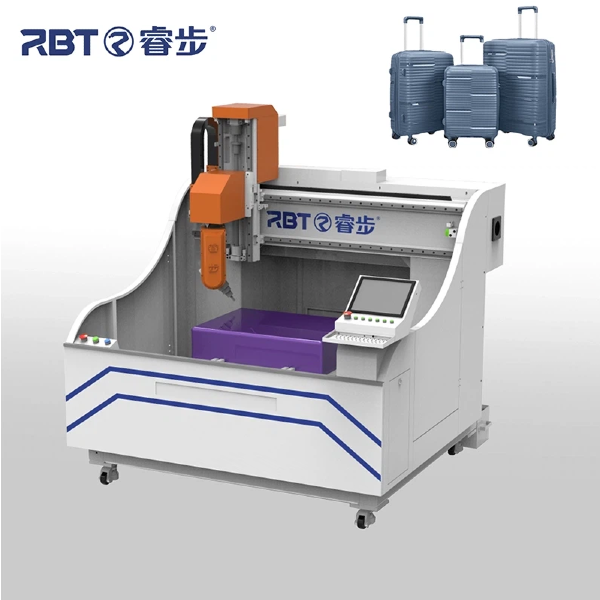
A 6-axis system becomes more useful when the shell is harder to access cleanly. RBT MACHINERY describes its six-axis cutting machine as suitable for complex angles, complex shapes, and intricate luggage components. That makes the advantage easy to understand: when the shell demands more dynamic tool movement, the sixth axis helps the machine approach the part more freely and handle difficult cutting positions with less compromise.
This matters most when the cut path is no longer straightforward. If edge transitions are more complex, if the shell includes harder-to-reach sections, or if multi-angle operations become routine instead of occasional, the sixth axis can reduce awkward workarounds and improve how naturally the cutting stage fits the part. In that situation, the extra axis is not just a feature. It becomes a practical process advantage.
The extra axis can also matter at the workflow level. If a factory wants broader automation and lower manual handling across a more varied shell program, additional motion freedom can reduce awkward repositioning and help the cutting stage fit better into a more advanced production cell. MakerVerse notes that 6-axis systems are typically used for highly intricate parts and can reduce manual labor in demanding applications, while RBT’s six-axis page also highlights energy-efficient design and advanced cutting capability.
That does not mean every automation plan requires 6-axis cutting. It means that when the shell program is both more variable and more demanding, added flexibility can become attractive not only for geometry, but also for overall workflow organization.
A more flexible machine does not automatically create better daily economics. Real return depends on how well the machine can be programmed, how stable the fixturing remains, and how confidently the team can run the process. RBT MACHINERY’s CNC selection article focuses on precision, automation, material compatibility, and long-term cost-effectiveness, which is a more practical comparison framework than axis count alone.
That is especially true in luggage production, where cutting accuracy directly affects shell fit, finish, and downstream assembly. If a machine offers more capability on paper but takes longer to stabilize in real use, the production advantage may be smaller than expected. Buyers should therefore compare the whole operating picture, not only the motion structure.
More capability usually brings more responsibility. As motion flexibility rises, maintenance, calibration, troubleshooting, and operator training often become more important. That does not make 6-axis the wrong choice. It simply means the extra flexibility should match the real needs of the shell program and the factory’s ability to use it well.
For many luggage factories, this is where the real decision becomes clear. If the line can benefit from broader motion and can support the added operating discipline, then 6-axis may be worth it. If not, a well-run 5-axis system may produce stronger day-to-day value.
The most practical decision starts with the shell itself. If the line mainly runs standard hard-shell products with repeated trim paths and stable tolerance targets, a 5-axis solution often delivers the best balance of precision, efficiency, and control. If the line is moving toward more complex contours, harder access angles, or a more flexible automated workflow, then 6-axis capability becomes more attractive. RBT MACHINERY’s site supports this kind of fit-based decision because it presents five-axis, six-axis, and other luggage cutting categories as different tools for different production needs.
Tolerance requirements should also be part of the decision. Some factories win through repeatable shell accuracy across large production runs. Others need more freedom because their product mix is changing or their shells are becoming more structurally demanding. The best machine is the one that supports the actual mix of geometry, volume, and workflow the line has today, not just the most advanced version available.
For factories focused on Luggage Making, the best cutting choice is not the one with the highest axis count. It is the one that gives each shell the right combination of precision, flexibility, and production efficiency without adding unnecessary complexity. RBT MACHINERY supports that decision with dedicated cutting categories for different luggage needs and a broader production-line understanding of how trimming, punching, and shell quality connect. If you are planning your next cutting upgrade, contact us to learn how our Six Axis CNC Cutting Machine solutions can support your luggage production line.
No. A 6-axis machine offers more motion freedom, but a 5-axis machine is often the more practical choice for repeated shell programs with stable contours and standard trim paths.
Its main advantage is strong precision with fewer setups, which helps improve edge quality, consistency, and material use in repeated shell production.
It becomes more valuable when shell geometry is more intricate, cutting angles are harder to access, or the workflow needs more flexibility for automation and varied part handling.
They should compare shell geometry, tolerance targets, programming difficulty, fixturing, maintenance load, and how well the machine matches the actual production mix.


