

Views: 0 Author: Site Editor Publish Time: 2026-04-07 Origin: Site
A hard-shell suitcase may look modern in a catalog, but turning that design into a reliable product is a very different challenge. That is why Luggage Making is becoming more important in 2026. The market is no longer impressed by appearance alone. Buyers want luggage that feels lighter in the hand, looks cleaner on the shelf, moves more smoothly in transit, and offers practical features that actually help during travel. For manufacturers, this shift means product success depends less on surface styling and more on process stability. RBT MACHINERY has spent more than 25 years serving the luggage industry with intelligent equipment solutions, and that experience aligns closely with what today’s hard-shell market requires: better sheet control, better thermoforming consistency, and better cutting accuracy for modern luggage production.
The most visible change in the market is not simply that luggage is becoming more technical. It is that travelers expect convenience without carrying unnecessary weight. A hard-shell suitcase still needs to protect belongings and handle repeated use, but it also has to feel easy to lift, easy to roll, and easy to manage in real travel situations. That balance is shaping how new products are developed.
In practical terms, “smart” no longer means adding as many functions as possible. Features only matter when they improve the travel experience. Better interior organization, easier handling, practical charging access, or integrated tracking support can all increase product appeal, but only if they do not make the case heavier or less comfortable to use. A suitcase that offers extra functions but feels bulky no longer matches current market expectations.
This is why smart and lightweight design are moving in the same direction. A brand that wants to launch more advanced luggage must now think carefully about how every feature fits into the overall product concept. The shell has to remain balanced, the structure has to remain clean, and the production line has to support that design without creating instability.
Premium hard-shell luggage used to depend heavily on a solid, heavy feel. Today, premium means something else. Buyers increasingly associate quality with ease of use, clean detailing, stable shell lines, and thoughtful functionality. A suitcase can feel strong without feeling oversized or heavy. It can look refined without appearing complicated.
That change affects manufacturing directly. Lightweight premium products demand more controlled production because thin, modern shells leave less room for error. If wall thickness becomes inconsistent, if the shell loses shape definition, or if edges are not trimmed cleanly, the product quickly loses the refined appearance that customers expect. In other words, premium no longer comes from visual impact alone. It comes from how well the product is executed from forming to final finishing.
Lightweight luggage manufacturing begins with the sheet, not with the finished case. If sheet quality is unstable, the final shell will reflect that instability during forming, trimming, or assembly. Inconsistent thickness, uneven heating response, or poor material control can lead to weak areas, shape variation, and reduced visual consistency.
This matters more now because the industry is asking the shell to do more with less material. Hard-shell luggage needs to remain strong enough for real use while also becoming easier to carry and more efficient in design. That balance cannot be achieved if the sheet entering production behaves unpredictably. A modern luggage line needs stable material preparation so that forming and cutting can perform consistently afterward.
RBT MACHINERY’s production logic reflects this reality. Instead of viewing sheet preparation, forming, and cutting as unrelated stages, they need to work as a connected luggage-making system. That approach is especially important for brands that want to develop lightweight collections across multiple sizes without losing consistency from one shell to the next.
Many buyers still assume that lighter shells must be weaker. In reality, that is not always true. A shell can remain light while still feeling reliable when its geometry, draw distribution, and forming process are controlled properly. Strength comes not only from material volume, but also from how the shell is shaped and how consistently it is produced.
This is one of the most important manufacturing ideas behind the 2026 trend. Lightweight design works best when the forming process supports even stretching, good structure, and stable part definition. If the process is well controlled, a thinner shell can still deliver the firmness and visual confidence customers want. If the process is unstable, even a thicker shell may still perform poorly.
For that reason, lightweight development is not simply a design decision. It is a production capability. The factories that can support lighter structures with better process discipline are more likely to succeed as the market continues shifting toward this style of hard-shell product.
Trend | What buyers expect | Manufacturing requirement | Relevant machine stage |
Lighter carry-ons | Easier lifting and smoother handling | Stable sheet thickness and controlled shell draw | Sheet preparation and forming |
Clean premium appearance | Sharp lines and uniform shell shape | Consistent heating and mold repeatability | Vacuum forming |
Practical smart features | Useful integration without bulk | Accurate openings and clean edges | CNC cutting |
Matching product families | Consistent look across sizes | Repeatable forming and trimming | Forming and cutting |
Better travel convenience | Durable but easy-to-use products | Balanced structure with efficient material use | Full production line |
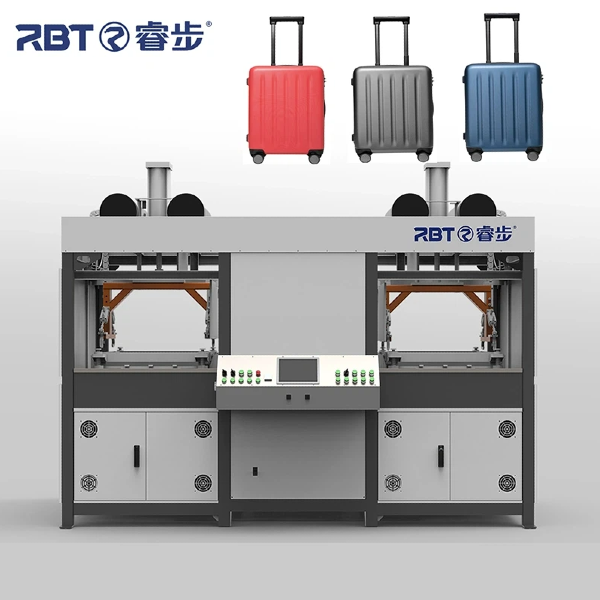
Many manufacturers try to respond to market change by expanding product variety. New textures, new shell patterns, and more model options can help attract attention, but they do not solve the core challenge behind lightweight luggage. The real requirement is consistency. Thin shells are more sensitive to process variation, so unstable heating, uneven vacuum response, or weak mold repeatability will create problems faster than before.
That makes forming stability more valuable than simply increasing the number of styles in the catalog. A production line that can repeatedly deliver good shell definition, stable thickness, and fewer defects will usually create more long-term value than a line that offers many designs but struggles to maintain output quality.
This is especially important for factories producing size ranges such as 20-inch carry-ons, medium shells, and large check-in cases within one collection. The design language may stay the same, but the forming demands can change. Consistency across that range requires equipment that supports repeatability, not just basic shape production.
A shell that is formed well still needs to be finished well. This is where cutting accuracy becomes part of the customer’s impression of quality. Clean edges, consistent openings, precise accessory positions, and stable hardware fit all affect whether the final product feels professionally made.
As luggage becomes lighter and more refined, rough or inconsistent trimming becomes more noticeable. A poorly cut edge can undermine the look of the entire case. Misaligned openings can complicate assembly and reduce confidence in the finished product. This is why CNC cutting now plays a larger role in product quality than many companies recognized in the past.
RBT MACHINERY’s luggage cutting solutions support this stage by helping manufacturers achieve cleaner shell trimming and more reliable part accuracy. In the current market, precision trimming is not only a technical requirement. It is part of how the product communicates quality.
The smartest luggage features are usually the most practical ones. Travelers value functions that reduce friction during a trip, not features that simply sound advanced in product marketing. Better compartment organization, easier access to travel essentials, practical charging arrangements, and location support are good examples of features that can improve daily use.
At the same time, every added function increases pressure on product design. If the shell becomes heavier, more crowded, or more difficult to produce, the feature may reduce product value instead of increasing it. This is why lightweight luggage requires discipline in feature planning. The goal is not to add more. The goal is to add better.
Modern buyers are also becoming more selective. They are more likely to appreciate simple improvements that solve real travel problems than decorative technology that adds complexity without clear benefit. For brands, that means successful smart luggage is usually based on restraint, not excess.
A good hard-shell suitcase does not need to advertise complexity. The best products often feel simple because their useful details are integrated cleanly into the structure. That kind of design is harder to manufacture than it looks. Openings must be accurate, shell geometry must remain stable, and all visible surfaces must stay clean after the functional details are added.
This is where coordinated production becomes important. Forming and cutting cannot be treated as isolated stages when the product concept depends on clean integration. The more refined the luggage design becomes, the more valuable stable equipment performance becomes behind the scenes.
For 2026, brands will benefit most when they focus on practical feature integration that supports lightweight construction instead of competing to add the longest feature list.
For brands developing new hard-shell programs, the direction of the market is clear. Luggage is becoming lighter, cleaner, and more purposeful, but that also makes good production more demanding. Success will not come from using trend language alone. It will come from building shells with dependable consistency, accurate trimming, and stable production performance across different sizes and styles.
That means product strategy and manufacturing capability must move together. Sheet stability, forming control, cooling performance, and cut precision are all part of whether a lightweight product can work commercially. If one stage is unstable, the product will struggle no matter how strong the original concept may be.
RBT MACHINERY supports this direction with a product portfolio built around the real stages of hard-shell luggage production. With over 25 years of experience, CE and ISO-certified systems, and industry partnerships with well-known luggage brands, the company’s role is not limited to supplying individual machines. It is to support a more consistent and efficient luggage-making process for brands that want to compete in the modern market.
RBT MACHINERY sees the future of hard-shell development as a balance between lighter construction, practical smart design, and stable manufacturing control. The strongest products in 2026 will be the ones that combine useful travel value with repeatable production quality. If your next collection is moving toward lighter shells and smarter design, contact us to learn how our Luggage Vacuum Forming Machine and cutting solutions can support your luggage production plans.
Because travelers increasingly want luggage that is easier to lift, easier to move, and still strong enough for repeated trips. Lightweight design is now closely connected with premium product expectations.
The most suitable smart features are practical ones, such as tracking support, organized storage, and useful charging access. They should improve travel convenience without adding unnecessary bulk.
Because thinner shells are less forgiving. If heating, vacuum response, or cooling is unstable, problems such as uneven thickness, poor definition, or shell variation appear more easily.
CNC cutting affects edge finish, opening accuracy, hardware fit, and overall shell consistency. Good cutting quality helps the finished suitcase look cleaner and assemble more smoothly.


