

Views: 0 Author: Site Editor Publish Time: 2026-03-13 Origin: Site
Luggage is an essential part of travel, providing a safe and convenient way to carry personal belongings from one destination to another. From large suitcases to small travel bags, luggage has become a critical component of every traveler’s journey. But what exactly does "luggage" mean? At its core, luggage refers to bags, suitcases, and containers used to pack, carry, and store personal items when traveling.
Over the years, the design and manufacturing of luggage have evolved significantly, with technological advancements improving their functionality, durability, and convenience. Today, luggage is not just a means to transport clothes and essentials – it also serves as a reflection of personal style, with many manufacturers incorporating sleek designs, durable materials, and even smart technology.
Suitcases: Large, rigid containers for storing clothes, shoes, and other items during travel.
Carry-ons: Smaller, portable bags that can fit into overhead compartments on airplanes.
Duffel Bags: Flexible, soft-sided bags used for shorter trips or casual travel.
Backpacks: Practical and comfortable, often used for day trips or hiking.
The growing demand for durable, functional, and stylish luggage has led to significant advancements in how luggage is manufactured. This is where companies like RBT Machinery come into play, providing innovative machinery for luggage production.
The concept of luggage has existed for centuries, but its form and functionality have transformed dramatically. In the early days of travel, luggage consisted of large trunks or wooden chests, which were often bulky and cumbersome. Over time, as transportation systems evolved (from horses to airplanes), luggage began to take on new forms.
Trunks and Chests: Early luggage was designed to be durable and sturdy but was often heavy and difficult to move.
Leather Bags: In the 19th century, leather bags became more common, especially among travelers who needed a more portable option.
Hard-shell Suitcases: With the development of plastics and lightweight materials, hard-shell luggage became widely popular. These suitcases offer durability and protection for fragile items inside.
Soft-shell Suitcases: These suitcases are made from fabric materials like nylon and polyester, offering flexibility and expandability for packing more items.
Smart Luggage: The latest trend in luggage, featuring built-in GPS tracking, biometric locks, and USB charging ports.
With the introduction of advanced manufacturing technology, the production of luggage has become faster, more efficient, and more precise. RBT Machinery plays a vital role in the production of luggage by providing high-quality machinery that enhances the durability and precision of the manufacturing process. The use of vacuum forming machines, CNC cutting machines, and assembly lines ensures that luggage products meet the required standards for both functionality and aesthetics.
Understanding the key components of luggage is essential to appreciating how machinery influences its production. These components work together to provide travelers with durable, reliable, and easy-to-use products.
The shell is the outermost layer of luggage, responsible for protecting the contents inside. It is usually made from plastic, metal, or fabric, depending on the type of luggage. Hard-shell luggage is commonly made from materials like polycarbonate, ABS (Acrylonitrile Butadiene Styrene), or aluminum, offering strength and impact resistance.
RBT Machinery plays an integral role in creating these hard-shell cases. For instance, the vacuum forming machine is used to mold high-quality shells with precision and efficiency. This machine ensures that the luggage’s exterior is smooth, strong, and ready for additional components.
The interior of the luggage includes compartments, dividers, and pockets that help keep belongings organized. It is designed to maximize storage space while providing easy access to items.
Many manufacturers use automated machines, such as sewing machines from RBT Machinery, to stitch fabric linings and dividers inside luggage. This ensures consistency in the product's quality and design.
Wheels and handles are crucial for the ease of use and portability of luggage. Traditionally, luggage used to be carried manually, but with the introduction of wheels, travelers could easily roll their bags.
Modern luggage often comes with 360-degree spinner wheels, which allow the suitcase to be moved in any direction with minimal effort. The handle is also designed for comfort and durability, often telescoping for easy storage and adjustment.
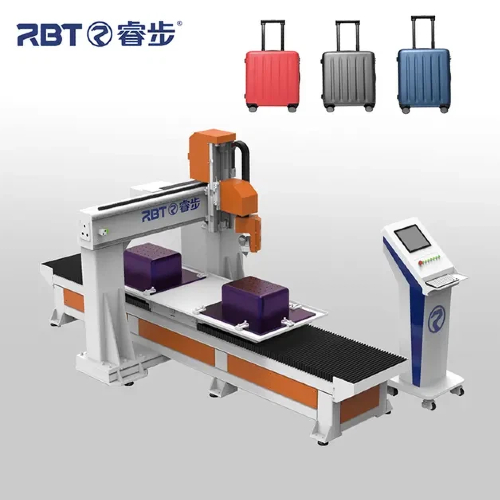
The production of luggage involves multiple stages, from raw material processing to final assembly. Each stage requires specialized machinery to ensure the product meets quality standards.
Step | Description |
Material Selection | The first step involves selecting the appropriate materials (plastic, fabric, metal). |
Molding and Forming | Using vacuum forming machines, the materials are molded into the shape of luggage shells. |
Cutting | CNC cutting machines are used to cut precise edges and components from the raw material. |
Sewing and Assembly | Fabric interiors are sewn and assembled, often with industrial sewing machines. |
Wheels and Handle Fitting | The wheels and handles are fitted onto the luggage, using specialized tools. |
Final Inspection | The finished luggage undergoes a final inspection to ensure everything is secure and functional. |
RBT Machinery plays a crucial role in automating many of these steps. From molding the luggage shell with vacuum forming to cutting the edges with CNC machines, RBT Machinery provides the tools that make luggage manufacturing more efficient and precise.
Luggage comes in various types, each designed for specific purposes. Depending on the size, material, and features, manufacturers must adapt their production processes to create luggage that suits different needs.
Type of Luggage | Description | Common Materials | Manufacturing Needs |
Carry-ons | Small, compact luggage that fits in overhead compartments. | Polycarbonate, Nylon | Requires precise molding and cutting for a lightweight design. |
Checked Luggage | Larger luggage that is stored in the airplane hold. | ABS, Polycarbonate | Requires durability and larger manufacturing tools. |
Duffel Bags | Soft, flexible bags often used for short trips. | Fabric, Polyester | Simple cutting and stitching for lightweight construction. |
Smart Luggage | High-tech luggage with built-in GPS and charging ports. | ABS, Polycarbonate | Integration of electronic components during assembly. |
Each type of luggage requires different processes to ensure it is lightweight, durable, and functional. RBT Machinery’s machines, such as vacuum forming, CNC cutting, and industrial sewing machines, ensure that all these requirements are met.
The luggage industry is evolving rapidly, with technology playing a key role in shaping its future. Smart luggage, equipped with features like GPS tracking, biometric locks, and USB charging ports, is becoming more popular. These technological advancements have made luggage more secure, convenient, and customizable.
RBT Machinery’s advanced equipment helps luggage manufacturers incorporate these technological features into their products. For example, during the molding process, vacuum forming machines create the outer shell of the luggage, leaving space for the inclusion of GPS tracking devices and biometric locks. Furthermore, the precise cutting done by CNC machines ensures that the compartments are correctly placed to house these electronic components.
As the travel industry continues to grow, the demand for innovative, sustainable, and high-tech luggage is likely to increase. Manufacturers are focusing on lighter, more durable materials, and more integrated technology.
RBT Machinery is at the forefront of these innovations, providing cutting-edge machinery that allows manufacturers to keep up with changing consumer preferences. From developing sustainable materials to integrating smart technology into luggage, the future of luggage is sure to be an exciting one.
Luggage plays a vital role in modern travel, and its production has evolved significantly over the years. With increasing demand for durable, functional, and stylish luggage, innovations in manufacturing technologies have become essential. At RBT Machinery, we are proud to contribute to the advancement of luggage production with our cutting-edge equipment, including vacuum forming machines, CNC cutters, and industrial sewing machines. These machines ensure that each piece of luggage meets the highest standards of quality, durability, and efficiency.
As we continue to support the luggage industry, we invite you to explore how RBT Machinery can enhance your manufacturing process. Whether you're looking to improve production efficiency, precision, or product design, our solutions are tailored to meet the unique needs of your business. Feel free to reach out to us for more information or to discuss how we can collaborate to take your luggage production to the next level. Let RBT Machinery help you create products that stand out in the market!
Machinery plays a vital role in automating various steps of the luggage manufacturing process, ensuring precision, efficiency, and consistency. RBT Machinery offers high-tech solutions for molding, cutting, and assembling luggage.
RBT Machinery provides equipment that helps streamline the production of luggage, including vacuum forming machines for molding shells and CNC cutters for precision cutting. Their equipment helps luggage manufacturers improve efficiency and quality.
Common materials used in luggage include polycarbonate, ABS, nylon, polyester, and fabric. These materials offer the durability and flexibility needed for different types of luggage.
Yes! With the help of RBT Machinery’s equipment, manufacturers can integrate smart features like GPS tracking and biometric locks into luggage during production.
The most common types include carry-on suitcases, checked luggage, duffel bags, and smart luggage. Each type requires specific manufacturing processes to ensure it meets user needs.


